Hook
Peter Thiel, the contrarian billionaire behind PayPal and Palantir, makes a provocative case that the most valuable companies do not compete — they build monopolies by creating something entirely new.
What It’s About
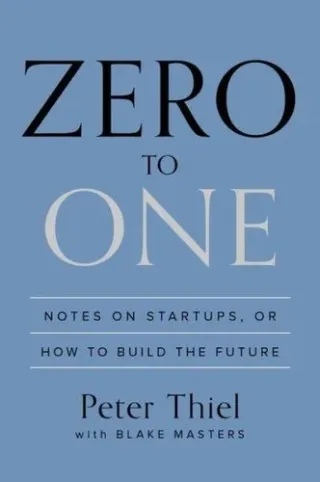
Zero to One began as a set of notes from a Stanford course Thiel taught on startups, compiled by one of his students, Blake Masters. The title captures Thiel’s central distinction: going from zero to one means creating something genuinely new, while going from one to n means copying things that already work. Thiel argues that real progress — the kind that transforms industries and creates enormous value — almost always comes from zero-to-one thinking.
The book challenges several widely held beliefs about business and innovation. Competition, Thiel argues, is not a sign of a healthy market but a sign that nobody has figured out how to create something truly differentiated. The businesses that generate lasting value are monopolies — not the predatory kind that regulators worry about, but creative monopolies that are so good at what they do that no one else comes close. Google does not compete with anyone in search because it built something fundamentally better. That is the kind of dominance Thiel wants founders to aim for.
Thiel also takes aim at the lean startup methodology and the idea that founders should iterate their way to product-market fit through small experiments. He believes that the most important startups begin with a bold, specific vision of the future and then work backward to make it real. He is skeptical of incrementalism in all its forms — in business, in technology, and in thinking. The book is intentionally provocative, and Thiel clearly enjoys challenging conventional wisdom. Not every argument holds up under scrutiny, but even the weaker points force you to think harder about assumptions you may not have examined.
Key Takeaways
Thiel’s “secret” framework is one of the book’s most useful ideas. He argues that every great company is built on a secret — a truth about the world that almost nobody else agrees with or has noticed. If an idea is obvious, it is already being pursued by many people and the opportunity is gone. If it is impossible, pursuing it is a waste. The sweet spot is the space in between: ideas that are true but not yet widely believed. The question he famously asks in every interview — “What important truth do very few people agree with you on?” — is a tool for finding those secrets.
The book also offers a clear-eyed analysis of what makes startups succeed or fail. Thiel emphasizes the importance of founding teams (small, aligned, and complementary), distribution (a great product with no distribution strategy will fail), and long-term thinking (planning for the future rather than reacting to the present). His framework for evaluating whether a market is worth entering — asking whether you can capture a significant share of a small market before expanding — is practical and underused. The book is short, dense, and every chapter contains at least one idea worth chewing on for a while.
The Verdict
A sharp, opinionated, and genuinely original business book that will change how you think about competition, innovation, and what it means to build something that matters.