Hook
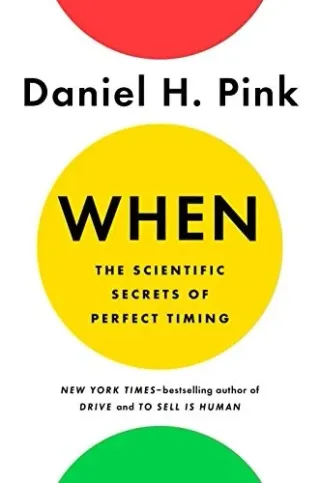
You’ve spent your whole life obsessing over what to do and how to do it, but Daniel Pink argues there’s a hidden dimension you’ve been ignoring — when to do it might matter just as much.
What It’s About
Daniel Pink digs into the science of timing — not the mystical, gut-feeling kind, but the kind backed by rigorous research in biology, psychology, and economics. The book explores how the time of day, the stage of life, and even the position within a larger sequence profoundly influence our performance, health, and decision-making. It turns out that timing isn’t an art. It’s a science, and most of us are getting it wrong.
The first section explores the daily rhythm that governs nearly everyone. Pink presents evidence that most people experience a predictable pattern: a peak in analytical ability in the morning, a trough in the early-to-mid afternoon, and a recovery period in the late afternoon and evening that favors creative and insight-based thinking. The implications are practical and immediate — schedule your most demanding cognitive work during your peak, push routine administrative tasks into the trough, and save brainstorming for the recovery period. Night owls, he notes, experience this pattern in reverse.
The second and third sections tackle beginnings, endings, and midpoints. Pink explores why fresh starts are so powerful (and how to create them artificially), why midpoints can either energize or demoralize us, and why endings shape our memory of entire experiences. He covers everything from school start times to hospital handoff protocols to the optimal time to go first in a competition. The research is fascinating, though the book occasionally feels like it’s stretching to fill its page count — some chapters are stronger than others, and the practical tips appended to each section can feel like an afterthought.
Key Takeaways
The most immediately useful insight is the daily peak-trough-recovery cycle. Understanding your own chronotype (whether you’re a lark, an owl, or somewhere in between) and structuring your day accordingly can yield significant improvements in productivity and well-being with relatively little effort. The research on afternoon performance dips is particularly sobering — hospitals see more errors, students score lower on tests, and judges make harsher rulings after lunch.
Beyond daily timing, Pink’s work on beginnings and endings offers genuinely practical wisdom. The concept of “temporal landmarks” — using dates like birthdays, new years, or even Mondays as psychological reset points — is a powerful tool for motivation. And his exploration of how endings affect our perception of experiences has implications for everything from project management to how you structure a vacation.
The Verdict
A well-researched and practical guide to an overlooked dimension of performance — not every chapter lands with equal force, but the core insights about daily timing are worth the read alone.