Hook
Toyota went from a small Japanese loom manufacturer to the most consistently profitable automaker on the planet. Jeffrey Liker spent twenty years studying how they did it and distilled it into fourteen principles that apply far beyond the factory floor.
What It’s About
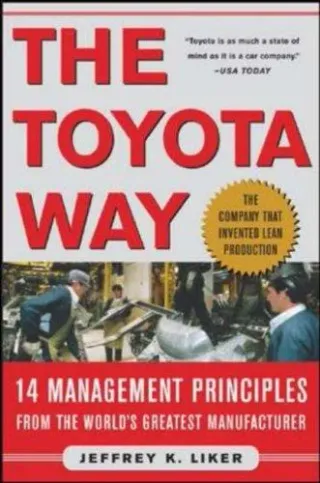
The Toyota Way is the definitive account of the management philosophy behind Toyota’s extraordinary success. Jeffrey Liker, a professor of industrial engineering at the University of Michigan, spent two decades embedded in Toyota’s operations, interviewing executives, engineers, and factory workers to understand the system from the inside out. The result is not a superficial overview of lean manufacturing but a deep exploration of the thinking and culture that make Toyota’s system work.
Liker organizes Toyota’s approach into fourteen principles, grouped into four categories: long-term philosophy, the right process producing the right results, developing people and partners, and continuous learning through problem-solving. The book goes well beyond the tools that most people associate with lean manufacturing — just-in-time delivery, kanban cards, and the like — and digs into the mindset that makes those tools effective. Many companies have tried to copy Toyota’s tools and failed because they did not understand that the tools are expressions of a deeper culture, not substitutes for one.
The most fascinating aspect of the book is how Toyota resolves apparent contradictions. The company is obsessively standardized yet deeply innovative. It empowers workers on the factory floor to stop the entire production line if they spot a defect, yet maintains extraordinary discipline in its processes. It invests heavily in long-term relationships with suppliers while holding them to exacting standards. Liker shows that these tensions are not contradictions at all but complementary elements of a system designed to produce continuous improvement over decades, not quarters.
Key Takeaways
The principle of “genchi genbutsu” — go and see for yourself — is perhaps the most universally applicable idea in the book. Toyota’s leaders are expected to understand problems by observing them firsthand at the source, not by reading reports in conference rooms. This practice ensures that decisions are grounded in reality rather than abstractions and prevents the kind of detachment from operational truth that plagues large organizations. It is a principle that translates directly to software companies, hospitals, schools, and any other organization where leaders risk becoming disconnected from the work being done.
The concept of building a culture of stopping to fix problems rather than working around them is equally powerful. In most organizations, the pressure to meet deadlines and quotas means that problems get patched over temporarily and then forgotten. Toyota’s system, embodied in the practice of “jidoka” (building quality in at every step), deliberately sacrifices short-term throughput for long-term quality. When a worker pulls the andon cord to stop the line, it is treated not as a failure but as an opportunity to improve the system permanently. This inversion of how most organizations treat problems — as things to be hidden rather than surfaced — is what allows Toyota to improve relentlessly year after year while competitors repeat the same mistakes.
The Verdict
Dense but rewarding — the most thorough and thoughtful book ever written about operational excellence, with lessons that extend well beyond manufacturing into any field where quality and continuous improvement matter.