Hook
Why do some ideas spread like wildfire while others fizzle out? Malcolm Gladwell reveals the hidden mechanics behind social epidemics, showing that massive change often hinges on surprisingly small factors.
What It’s About
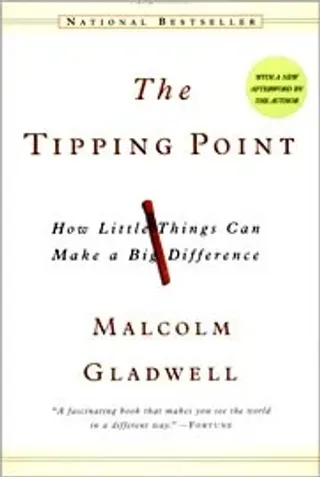
The Tipping Point explores how ideas, trends, products, and behaviors spread through society in the same way that viruses spread through a population. Gladwell argues that there is a critical moment — a tipping point — where a small change can push something across a threshold into widespread adoption. Think of it as the moment when a match finally catches and becomes a blaze.
Gladwell identifies three key rules that govern these social epidemics. First, there is the Law of the Few, which argues that certain rare individuals — Connectors who know everyone, Mavens who accumulate knowledge, and Salesmen who can persuade anyone — play an outsized role in spreading ideas. Second, there is the Stickiness Factor, which explains why some messages are inherently more memorable and actionable than others. Finally, the Power of Context reveals how sensitive we are to our environment and how seemingly minor changes in setting can dramatically alter behavior.
What makes this book distinctive is Gladwell’s storytelling. He weaves together case studies from the resurgence of Hush Puppies shoes to the dramatic drop in New York City crime rates, from the success of Sesame Street to the midnight ride of Paul Revere. Each story illuminates a principle without ever feeling like a lecture. Gladwell has an uncanny ability to make sociological research feel as gripping as a detective novel, and this was the book that established him as one of the most influential popular science writers of the modern era.
Key Takeaways
The most powerful insight from The Tipping Point is that you do not need to reach everyone to start a movement — you need to reach the right people in the right way at the right time. This reframes how we think about marketing, social change, education, and even personal influence. Instead of brute-force approaches, Gladwell suggests precision: find the connectors, craft a sticky message, and pay attention to context.
For anyone working in business, activism, or communication, this book provides a lens for understanding why some efforts gain traction and others do not. It also challenges the assumption that big problems require big solutions. Sometimes the smallest, most targeted intervention can cascade into enormous change. The framework is not a step-by-step playbook, but it fundamentally shifts how you observe the world around you.
The Verdict
A foundational read for anyone interested in how change happens — Gladwell’s debut remains as relevant and eye-opening today as it was when it first sparked a cultural conversation about the hidden forces shaping our world.