Hook
The ancient Stoics believed that every obstacle contains a hidden advantage — and Ryan Holiday makes a surprisingly compelling case that this 2,000-year-old philosophy is the ultimate operating system for modern life.
What It’s About
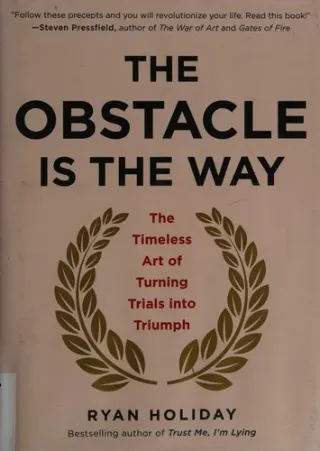
Ryan Holiday takes the core insight of Stoic philosophy — that we don’t control what happens to us, only how we respond — and builds a practical framework around it. The book is organized into three disciplines: Perception (how you see the problem), Action (how you respond to it), and Will (how you endure what you can’t change). Each section is illustrated with stories of historical figures who turned adversity into advantage, from Ulysses S. Grant’s unshakeable calm under fire to Amelia Earhart’s refusal to be defined by the barriers placed in her path.
The central argument is not that obstacles are secretly good or that suffering should be welcomed. It’s more nuanced than that. Holiday argues that obstacles are inevitable, and that the way you engage with them determines whether they become walls or stepping stones. The Stoic approach isn’t about suppressing emotions or pretending everything is fine — it’s about training yourself to see situations clearly, act decisively on what you can control, and accept with grace what you cannot. The historical examples range widely, from business leaders to athletes to political figures, and Holiday weaves them together with a storyteller’s instinct.
What makes the book work is its brevity and energy. At just over 200 pages, Holiday doesn’t belabor his points. Each chapter is short, punchy, and built around a single idea backed by a vivid story. The writing has a muscular directness that mirrors the philosophy it describes. Some readers may find the relentless positivity about adversity a bit much, but Holiday earns it by grounding his arguments in genuine history rather than shallow platitudes.
Key Takeaways
The most powerful idea is the discipline of perception — the ability to see obstacles as they truly are rather than as your fears and emotions paint them. Holiday argues that most of the suffering we experience comes not from the obstacle itself but from our judgment about it. Training yourself to strip away the emotional overlay and see the situation objectively is the first and most important step.
The action section is equally valuable, emphasizing persistence, creativity, and pragmatism. Holiday makes the case that bold action in the face of difficulty isn’t reckless — it’s the only rational response. The final section on will addresses the hardest challenges, the ones that can’t be solved through perception or action alone, and offers the Stoic practice of accepting mortality and impermanence as the ultimate source of strength. Together, the three disciplines form a remarkably cohesive approach to life’s inevitable difficulties.
The Verdict
A brisk, potent introduction to applied Stoicism that earns its place on the shelf of anyone who wants to face difficulty with more clarity and less anxiety.