Hook
We have the formula backward: success does not lead to happiness — happiness leads to success. Shawn Achor spent over a decade researching this at Harvard, and the evidence is more convincing than you might expect.
What It’s About
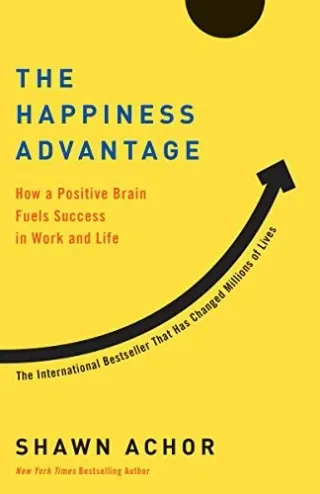
The Happiness Advantage grew out of Shawn Achor’s wildly popular Harvard course on positive psychology and his viral TED talk. The book challenges the conventional wisdom that we need to work harder to be more successful, and that success will eventually make us happy. Drawing on research from neuroscience, psychology, and behavioral economics, Achor argues that the relationship runs the other way: when our brains are in a positive state, we are more creative, more productive, more resilient, and more likely to achieve our goals.
The book is organized around seven principles. The Happiness Advantage itself is the idea that a positive brain gives you a measurable edge over a neutral or negative one. The Fulcrum and the Lever explores how shifting your mindset can change your objective reality. The Tetris Effect shows how training your brain to spot patterns of possibility rather than patterns of failure can transform your experience of work and life. Falling Up is about how adversity can be a launchpad rather than a dead end. The Zorro Circle explains how to regain control when feeling overwhelmed by focusing on small, manageable goals. The 20-Second Rule provides a practical strategy for building good habits and breaking bad ones. And Social Investment makes the case that your relationships are the single greatest predictor of happiness and success.
Achor writes with genuine warmth and humor, which makes the research go down easy. He is a natural storyteller, and his examples range from Harvard freshmen to tax auditors to military recruits. The book manages to be evidence-based without being dry, and practical without being simplistic. It is the kind of book that makes you rethink assumptions you did not even know you had.
Key Takeaways
The most powerful insight is that happiness is not the result of success — it is the precondition for it. Research consistently shows that people who cultivate positive emotions outperform their peers on virtually every measurable dimension: productivity, creativity, engagement, health, and resilience. This is not about forced optimism or ignoring real problems. It is about training your brain to operate from a positive baseline so that you have more cognitive resources available when challenges arise.
The practical tools are refreshingly simple. Achor recommends specific daily habits — writing down three things you are grateful for, journaling about one positive experience, exercising, meditating, and performing random acts of kindness — and cites research showing that these small investments yield significant returns within weeks. The 20-Second Rule is particularly useful: by reducing the activation energy for good habits (and increasing it for bad ones), you can rewire your default behaviors without relying on willpower alone. For anyone who has ever felt that working harder is not translating into greater fulfillment, this book offers both the explanation and the remedy.
The Verdict
A research-backed, genuinely enjoyable read that flips the success-then-happiness script and gives you practical tools to start benefiting immediately.