Hook
The most dangerous thing in any organization is not incompetence — it is silence. Amy Edmondson makes a rigorous, compelling case that psychological safety is the foundation upon which every high-performing team is built.
What It’s About
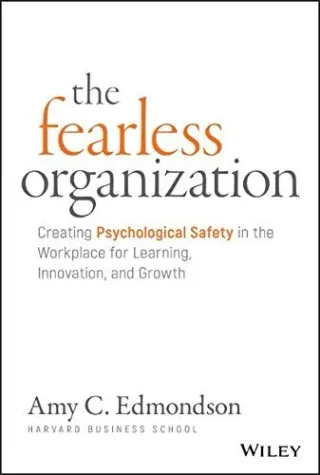
The Fearless Organization is the definitive work on psychological safety in the workplace, written by the Harvard Business School professor who pioneered the concept. Edmondson defines psychological safety as a shared belief that the team is safe for interpersonal risk-taking — that you can speak up with questions, concerns, mistakes, or half-formed ideas without being punished or humiliated. It sounds simple, but the absence of this quality has contributed to catastrophic failures in healthcare, aviation, banking, and technology.
Edmondson draws on decades of research and real-world case studies to illustrate her points. She examines the Volkswagen emissions scandal, where a culture of fear prevented engineers from speaking up about impossible targets. She looks at how Google’s Project Aristotle found that psychological safety was the single most important factor distinguishing high-performing teams. She explores hospitals where nurses felt unable to question doctors, leading to preventable patient deaths. These are not abstract management theories — they are stories with real consequences.
What separates this book from the flood of leadership titles is its rigor and practicality. Edmondson does not simply argue that psychological safety matters; she provides a clear framework for how leaders at any level can create it. She outlines specific behaviors: framing work as learning problems rather than execution problems, acknowledging your own fallibility, and modeling curiosity by asking genuine questions. The book is structured to move from understanding the concept to diagnosing your own organization to taking concrete action.
Key Takeaways
The central lesson is that innovation, quality, and growth are impossible without candor, and candor is impossible without safety. Leaders who punish messengers, dismiss concerns, or create an atmosphere where failure is unacceptable are not building a culture of excellence — they are building a culture of concealment. The book gives you the language and tools to recognize when silence is masking problems in your own team.
Equally valuable is the distinction Edmondson draws between psychological safety and mere comfort. A psychologically safe environment is not one where everyone agrees or avoids conflict. It is one where productive disagreement is welcomed and people hold each other to high standards precisely because they feel safe enough to be honest. This nuance alone makes the book worth reading for any leader who has confused niceness with effectiveness.
The Verdict
Essential reading for anyone who leads a team, manages people, or wants to understand why some organizations learn and adapt while others repeat the same mistakes until they collapse.