Hook
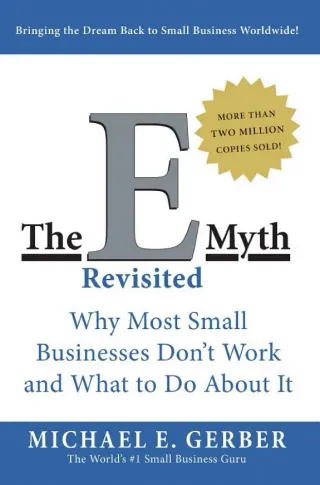
Most small businesses fail not because their owners lack talent but because talented people assume that being good at a skill means they will be good at running a business built around that skill. Michael Gerber calls this the E-Myth, and understanding it might save your business.
What It’s About
The “E-Myth” is the Entrepreneurial Myth — the mistaken belief that most businesses are started by entrepreneurs. In reality, Gerber argues, most are started by technicians having an entrepreneurial seizure. A brilliant baker opens a bakery. A talented programmer starts a software company. A skilled plumber launches a plumbing business. And then they discover, often painfully, that knowing how to do the work and knowing how to build a business that does the work are completely different competencies.
Gerber frames the problem through three internal personas that every business owner must balance: the Entrepreneur, who lives in the future and dreams of possibilities; the Manager, who craves order, systems, and predictability; and the Technician, who lives in the present and just wants to do the work. Most small business owners are overwhelmingly Technician-dominant, which means they end up building a job for themselves rather than a business. They work in the business instead of on the business, and eventually they burn out.
The solution Gerber proposes is what he calls the Turn-Key Revolution, inspired by the franchise model. The idea is that every small business should be built as if it were going to be franchised — even if it never will be. This means creating documented systems for every function, building processes that do not depend on any single person’s genius, and designing the business to run without the owner’s constant presence. Gerber walks through this transformation using a fictional narrative about a pie shop owner named Sarah, which makes the concepts feel concrete and relatable.
Key Takeaways
The core takeaway is the distinction between working in your business and working on your business. Gerber argues that the most important work a business owner can do is to step back from the day-to-day operations and design systems that allow the business to function independently. This is not about removing yourself from the work you love — it is about making sure the business does not collapse the moment you step away.
The franchise prototype concept is the book’s most actionable framework. Gerber challenges readers to document every process, create consistency in customer experience, and build the business as a system rather than as an extension of their personal effort. The narrative style with Sarah can feel a bit slow at times, and some of the examples are dated. But the fundamental insight — that systemization is freedom, not constraint — remains as relevant today as it was when the book was first published. For any small business owner who feels trapped by their own creation, this book is a necessary wake-up call.
The Verdict
A genuinely transformative book for small business owners — the core framework of working on your business rather than in it has launched a thousand successful companies and remains indispensable.