Hook
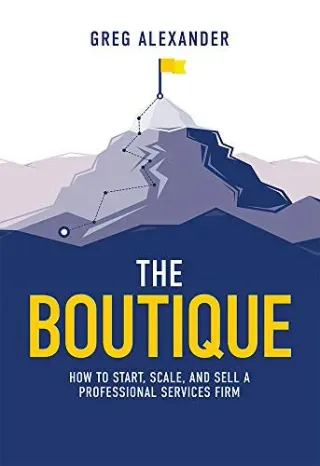
Most professional services firms never scale beyond a handful of people, and their founders never build real equity. Greg Alexander maps the lifecycle of a boutique firm and shows exactly where most get stuck — and how to break through.
What It’s About
The Boutique is written specifically for founders and leaders of small professional services firms — consultancies, agencies, advisory practices, and similar knowledge-based businesses. Alexander, who built and sold a boutique firm himself before founding Collective 54 (a community for services firm founders), brings hard-won credibility to a topic that is surprisingly underserved in business literature. Most business books focus on product companies or large enterprises. This one is unapologetically for the small firm owner trying to figure out whether to grow, how to grow, and when to exit.
The book is structured around a three-stage lifecycle: Grow, Scale, and Exit. In the Grow phase, Alexander covers finding your niche, attracting clients, and building a team beyond yourself. In Scale, he addresses the thorny challenges of removing yourself as the bottleneck, creating repeatable processes, and building a firm that can operate without the founder in every meeting. In Exit, he discusses how to make your firm attractive to acquirers and how to think about valuation in professional services, where the “product” walks out the door every evening.
Alexander writes in a direct, no-nonsense style. The chapters are short and punchy, each ending with actionable takeaways. He is not trying to impress you with theory — he is trying to give you a practical framework you can apply to your firm this quarter. The book is particularly strong on the uncomfortable truths of professional services: that most firms are just glorified jobs, that founder dependency destroys value, and that the difference between a lifestyle business and a scalable firm comes down to a few critical decisions made early.
Key Takeaways
The most useful framework is Alexander’s distinction between a firm that is founder-led versus one that is market-led. A founder-led firm grows based on the personal reputation and relationships of the founder, which creates a natural ceiling. A market-led firm has built systems, intellectual property, and a brand that attract clients independent of any single individual. Understanding where you sit on this spectrum — and what it takes to move along it — is worth the price of the book.
The book also provides clarity on when not to scale. Alexander is honest that not every boutique should try to become a large firm. Some founders are better served by building a highly profitable small practice and optimizing for lifestyle rather than exit. This candor is refreshing in a genre that often equates growth with virtue.
The Verdict
A focused, practical guide for professional services firm founders who want to understand the path from solo practitioner to scalable, sellable business — not flashy, but full of hard-earned wisdom that is difficult to find elsewhere.