Hook
What if the most successful people in the world share one habit in common — and it starts before the sun comes up? Robin Sharma has been preaching the gospel of early rising for decades, and this book is his most ambitious attempt to convert you.
What It’s About
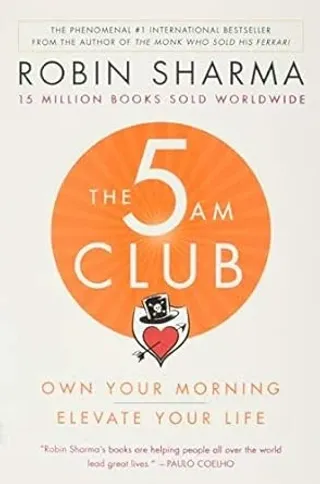
The 5 AM Club is Robin Sharma’s manifesto on the transformative power of waking up at five in the morning. Rather than writing a straightforward how-to guide, Sharma chose to deliver his message through a fictional narrative. The story follows an entrepreneur on the verge of burnout and a young artist who meet a quirky billionaire named Mr. Riley. This eccentric mentor takes them on a globe-trotting journey — from Mauritius to Rome to South Africa — while teaching them the principles behind what he calls the 20/20/20 formula: twenty minutes of exercise, twenty minutes of reflection, and twenty minutes of learning, all before six in the morning.
The core thesis is that owning the first hour of your day — before the world starts demanding your attention — sets the tone for everything that follows. Sharma layers in concepts from neuroscience, productivity research, and peak performance psychology to argue that early morning routines enhance focus, creativity, energy, and resilience. He introduces frameworks like the Twin Cycles of Elite Performance (balancing intense work with deep recovery) and the Four Interior Empires (mindset, heartset, healthset, and soulset) to give structure to his philosophy of personal mastery.
The fictional format is where opinions will divide. At its best, the story makes the concepts memorable and emotionally resonant. At its worst, the dialogue can feel stilted, the billionaire character edges into caricature, and the globetrotting backdrop sometimes distracts from the substance. The book is also significantly longer than it needs to be — the core ideas could easily fit in half the pages. Sharma has a tendency to repeat his key points multiple times, which will either feel like helpful reinforcement or unnecessary padding depending on your patience.
Key Takeaways
The 20/20/20 formula is the book’s most actionable contribution. The first twenty minutes of vigorous exercise jumpstart your neurotransmitters and cortisol cycle. The second twenty minutes of meditation, journaling, or prayer create mental clarity. The final twenty minutes of studying, reading, or skill-building compound over time into a significant knowledge advantage. The framework is genuinely useful and more structured than most morning routine advice.
Sharma also makes a compelling case for the importance of recovery and solitude. His Twin Cycles concept — alternating between high-performance periods and deep rest — aligns with research on sustainable peak performance. The emphasis on protecting your cognitive bandwidth from digital distractions, especially in the morning hours, is advice that has only become more relevant since the book’s publication. However, the book assumes everyone can simply start waking up at five, which glosses over the realities of different chronotypes, demanding family situations, and the fact that sleep deprivation can negate every benefit the routine promises. Take what works and leave the rest.
The Verdict
Contains genuinely useful ideas about morning routines and peak performance, but buried under a bloated narrative and repetitive delivery — skim the frameworks and skip the fiction.