Hook
In a world that worships busyness, Ryan Holiday makes a compelling case that the real competitive advantage is the ability to be still — and that history’s greatest performers all knew it.
What It’s About
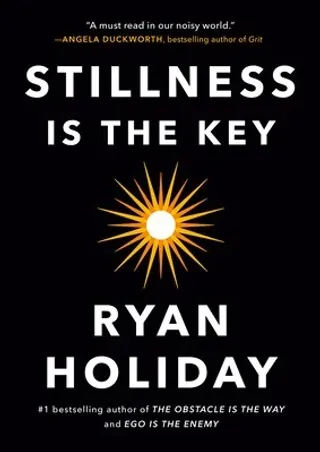
Stillness Is the Key is the final book in Ryan Holiday’s trilogy on Stoic virtues, following The Obstacle Is the Way and Ego Is the Enemy. Where those books focused on resilience and humility, this one tackles the hardest virtue of all for modern people: the ability to be calm, focused, and present in a world designed to fracture your attention.
Holiday structures the book around three domains: mind, spirit, and body. In the section on the mind, he explores what it means to think clearly — to slow down, limit inputs, and create space for genuine insight rather than reactive decision-making. He draws on figures like John F. Kennedy during the Cuban Missile Crisis and the artist Marina Abramovic to show how stillness of thought leads to better outcomes under pressure. The spirit section goes deeper, examining how inner peace comes from aligning your actions with your values, letting go of the need for external validation, and cultivating a relationship with something larger than yourself. The body section addresses the physical foundations of stillness: sleep, routine, walking, and the discipline to say no to excess.
What makes the book work is Holiday’s signature approach of weaving historical anecdotes into practical philosophy. Each short chapter uses a story from history, sports, art, or politics to illustrate a single principle, then distills it into something actionable. The chapters are deliberately brief, making the book easy to pick up and put down — which feels appropriate for a book about not rushing through life. Holiday writes with conviction but avoids being preachy, and the range of examples (from Confucius to Tiger Woods to Fred Rogers) keeps things from feeling one-note.
Key Takeaways
The central argument is that stillness is not passive — it is an active, deliberate practice that the best leaders, thinkers, and creators throughout history have cultivated. In a culture that equates busy with productive and noise with importance, learning to slow down is a genuine competitive advantage. Holiday makes the case that stillness improves decision-making, deepens creativity, and protects against burnout.
Practically, the book suggests concrete habits: journaling, walking without your phone, establishing a consistent routine, limiting information intake, and building solitude into your schedule. It also pushes readers to examine their relationship with ambition and desire, arguing that the restless pursuit of more is often the biggest obstacle to both happiness and performance. The book does not ask you to become a monk — it asks you to find pockets of stillness within an active life, and it provides a philosophical foundation for doing so that draws on both Eastern and Western traditions.
The Verdict
Beautifully written and urgently needed — a philosophical call to slow down that manages to be both inspiring and immediately actionable.