Hook
Procrastination is not a time management problem — it is an emotion management problem. Timothy Pychyl, one of the world’s leading researchers on the topic, distills decades of scientific study into a concise, honest guide to understanding why we delay and how to stop.
What It’s About
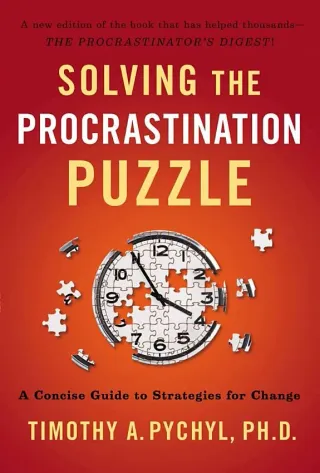
Solving the Procrastination Puzzle is a slim, research-grounded book that cuts through the noise surrounding procrastination. Pychyl, a psychology professor at Carleton University who has spent his career studying this behavior, argues that most advice about procrastination misses the point entirely. Procrastination is not about poor planning or laziness. It is about our inability to regulate negative emotions associated with a task — boredom, anxiety, frustration, resentment, or self-doubt. We put things off not because we cannot manage our time, but because we cannot manage our feelings.
The book is organized as a series of concise chapters, each focused on a specific aspect of the procrastination puzzle. Pychyl explains the gap between intention and action, why we give in to feeling good now at the expense of our future selves, and how our brains rationalize delay with remarkable creativity. He draws on research in psychology, neuroscience, and behavioral science to show that procrastination is a deeply human tendency rooted in how our brains process short-term versus long-term rewards.
What sets this book apart from the self-help crowd is its intellectual honesty. Pychyl does not promise a magic cure. Instead, he offers a set of evidence-based strategies: recognizing that you do not need to feel like doing something in order to start, using implementation intentions (specific if-then plans), reducing the ambiguity of tasks, and practicing self-forgiveness when you inevitably slip. The book is short enough to read in a single sitting, which feels intentionally ironic — a book about procrastination that you can actually finish.
Key Takeaways
The most transformative insight is deceptively simple: motivation follows action, not the other way around. Most procrastinators wait until they feel ready, inspired, or in the right mood to begin. Pychyl’s research shows that just getting started — even in the smallest possible way — tends to generate the motivation and momentum you were waiting for. This flips the conventional wisdom and gives you a practical tool you can use immediately.
The book also reframes the relationship between procrastination and self-compassion. Beating yourself up for procrastinating actually makes the problem worse by adding guilt and shame to the pile of negative emotions you are already avoiding. Pychyl presents evidence that self-forgiveness after a bout of procrastination leads to less procrastination in the future, not more. It is a counterintuitive but well-supported finding that can change your entire approach to productivity.
The Verdict
A brief, science-backed guide that reframes procrastination as an emotional challenge rather than a character flaw — ideal for anyone who has tried every productivity hack and still finds themselves avoiding the work that matters most.