Hook
What happens when a company has the opportunity to scale, take outside investment, and grow as fast as possible — and deliberately chooses not to? These fourteen companies made that choice, and they are thriving because of it.
What It’s About
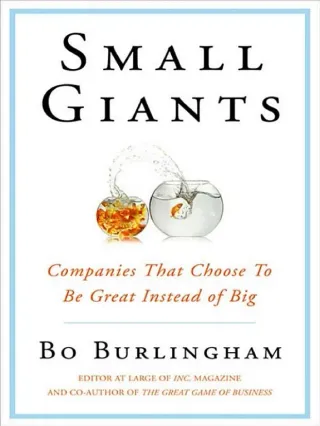
Small Giants is Bo Burlingham’s exploration of companies that chose to be great instead of big. As a longtime editor at Inc. magazine, Burlingham had a front-row seat to the dominant narrative of American business: grow fast, raise capital, scale relentlessly, and aim for an exit. But he kept encountering companies that defied this script — businesses that had the opportunity and ability to grow much larger but consciously decided to focus on being exceptional at what they do, deeply connected to their communities, and genuinely fulfilling places to work.
The book profiles fourteen such companies across a range of industries: Anchor Brewing, Zingerman’s Deli, CitiStorage, Clif Bar, Righteous Babe Records, and others. What they share is not a specific size or industry but a set of qualities. Each has a deeply engaged leader who prioritized purpose over growth. Each cultivated unusually strong relationships with employees, customers, suppliers, and their local communities. Each found a way to be profitable without sacrificing the soul of the business. And each faced a critical inflection point where they chose to stay small and great rather than become big and mediocre.
Burlingham is a skilled journalist, and the book reads like a series of interconnected profiles rather than a prescriptive business manual. He lets the stories breathe and allows the common threads to emerge organically rather than forcing them into a rigid framework. The result is a book that is more inspiring than instructional — you finish it not with a checklist but with a fundamentally different way of thinking about what business success can look like. For entrepreneurs who feel pressured to pursue growth for its own sake, Small Giants offers both permission and a roadmap for a different path.
Key Takeaways
The most striking insight is that the companies profiled did not stumble into their smallness — they chose it deliberately and strategically. This required resisting enormous external pressure from investors, advisors, and the broader business culture that equates bigger with better. The leaders of these companies were clear about what mattered most to them and were willing to sacrifice growth opportunities that would have compromised those priorities.
Several common traits emerge across the profiles. These companies invest heavily in culture, treating employees as genuine stakeholders rather than resources. They maintain unusually intimate relationships with their customers, often knowing them by name. They are deeply embedded in their communities in ways that large companies rarely manage. And their leaders tend to have a clear sense of purpose that goes beyond financial returns. The book does not argue that growth is wrong — it argues that growth should be a choice, not a default. For the right business with the right leader, staying small can be the smartest, most ambitious decision of all. This message has only become more resonant as more people question the grow-at-all-costs mentality.
The Verdict
A quietly revolutionary business book that gives entrepreneurs permission to define success on their own terms — essential reading for anyone who has ever wondered whether bigger is truly better.