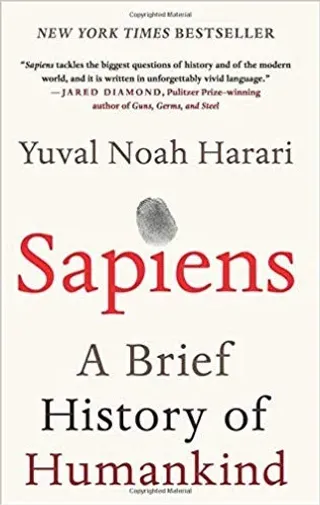
Hook
Seventy thousand years ago, Homo sapiens was an unremarkable animal living in a corner of Africa. Today, we’ve walked on the moon, split the atom, and connected billions of minds through a global network. Yuval Noah Harari wants to explain how — and his answer is stranger than you’d expect.
What It’s About
Sapiens traces the entire arc of human history through three major revolutions: the Cognitive Revolution (when we learned to think in abstractions), the Agricultural Revolution (when we traded freedom for wheat fields), and the Scientific Revolution (when we admitted our own ignorance and started making real progress). It’s a massive scope — 70,000 years in under 500 pages — but Harari pulls it off by focusing not on dates and battles, but on the big structural shifts that changed everything.
The book’s most provocative idea is that Homo sapiens conquered the world not through superior strength or intelligence, but through our unique ability to believe in shared fictions. Money, nations, human rights, corporations, religion — none of these exist in any objective sense. They’re stories we collectively agree to believe, and that shared belief is what allows millions of strangers to cooperate. It’s a deceptively simple insight that, once you see it, changes how you look at almost everything.
Harari is also refreshingly willing to challenge sacred cows. The Agricultural Revolution, typically framed as humanity’s greatest leap forward, gets recast as what he calls history’s biggest fraud — a deal where we traded the varied, relatively leisurely life of hunter-gatherers for backbreaking labor, worse nutrition, and new forms of social hierarchy. Whether you agree or not, it forces you to question assumptions you didn’t even know you had.
Key Takeaways
The lasting power of Sapiens is in its frameworks, not its facts. After reading it, you’ll start noticing “shared fictions” everywhere — in brand loyalty, political ideologies, even the concept of weekends. It’s a book that installs a new lens for seeing the world, and that lens doesn’t go away.
That said, Harari paints with an extremely broad brush. Specialists in any given field will find oversimplifications and debatable claims. He presents contested theories as settled fact more often than a careful academic would. But that’s partly the trade-off of writing a book this ambitious — if he’d hedged every claim, it would be 2,000 pages and nobody would read it.
The Verdict
If you’ve ever wondered how a fairly average primate ended up running the planet, this is the most thought-provoking 464 pages you’ll spend on the question. Essential reading for the curious-minded, even if you end up arguing with half of it.