Hook
What if everything you’ve been told about building a business — write a business plan, seek investors, hire fast, outwork the competition — is not just wrong but actively harmful?
What It’s About
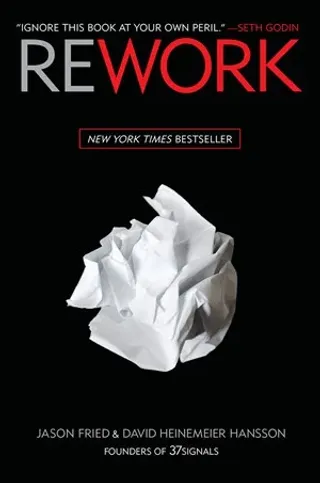
Rework is a manifesto for a different kind of business. Jason Fried and David Heinemeier Hansson, the founders of Basecamp (now 37signals), distill over a decade of running a profitable, intentionally small software company into a series of sharp, contrarian essays. The book is structured as dozens of short chapters, most just two or three pages, each attacking a piece of conventional business wisdom.
The arguments are provocative and refreshingly specific. Meetings are toxic — not because all meetings are bad, but because most are poorly run and could be replaced by a well-written memo. Workaholism is not a virtue — it’s a sign of poor prioritization. You don’t need more people, more funding, or more features. You need fewer distractions, clearer thinking, and the discipline to ship something small and real instead of endlessly planning something big and theoretical.
Fried and Hansson write from experience. Basecamp was bootstrapped, profitable from early on, and has remained deliberately small while competing against companies with hundreds of millions in venture capital. Their philosophy — build less, charge for your product, grow at a pace you can sustain — has aged remarkably well in an era where countless venture-backed startups have imploded. The book does not pretend to be a universal blueprint, but it makes a compelling case that there is more than one way to build a lasting business.
Key Takeaways
The book’s most enduring contribution is the idea of “less as a competitive advantage.” While competitors pile on features, staff, and complexity, Fried and Hansson argue that the real edge comes from saying no — to meetings, to features, to customers who want you to become something you’re not. Constraints, they argue, are not obstacles; they are creative fuel.
They also make a strong case for shipping early and iterating. Perfectionism is reframed not as a standard of excellence but as a form of procrastination. Launch something real, learn from it, and improve. The feedback you get from actual users is worth more than any amount of planning in a vacuum.
The Verdict
A fast, punchy read that remains one of the best books on building a lean, profitable business — especially valuable for anyone who has ever felt that the startup playbook of “raise money, grow fast, figure out profit later” doesn’t quite feel right.