Hook
What if the way we organize work — hierarchies, budgets, job descriptions, performance reviews — is not the pinnacle of human collaboration but merely one stage in an ongoing evolution? Frederic Laloux paints a bold vision of what comes next.
What It’s About
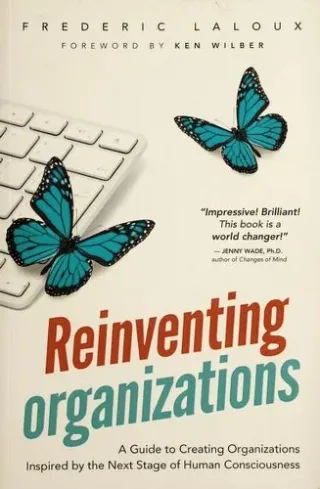
Reinventing Organizations is one of the most ambitious management books of the past decade. Laloux, a former McKinsey consultant, traces the evolution of human organizations through a series of developmental stages, each represented by a color. Red organizations are based on fear and power (think street gangs). Amber organizations run on rigid hierarchy and formal roles (the military, the Catholic Church). Orange organizations optimize for achievement and meritocracy (most modern corporations). Green organizations prioritize culture, empowerment, and stakeholder value (think Ben & Jerry’s or Southwest Airlines). And then there is Teal — the emerging paradigm that Laloux argues represents the next leap.
Teal organizations, as Laloux describes them, share three breakthroughs: self-management (replacing hierarchy with distributed authority and peer-based decision-making), wholeness (inviting people to bring their full selves to work rather than wearing a professional mask), and evolutionary purpose (letting the organization’s purpose evolve organically rather than being dictated top-down through strategic planning). These are not theoretical constructs. Laloux profiles a dozen real organizations operating this way, from Buurtzorg (a Dutch healthcare organization with 15,000 nurses and almost no management) to Morning Star (the world’s largest tomato processor) to FAVI (a French automotive supplier).
The strength of the book lies in these case studies. Laloux goes deep into how these organizations actually work day to day — how they make decisions without bosses, how they handle conflict, how they set compensation, and how they onboard new people into a radically different way of working. It is a genuinely eye-opening look at what is possible when you question assumptions that most of us take for granted. The book is long and occasionally dense, and some readers may find the developmental framework too neat or the evolutionary language too idealistic. But even skeptics will find the case studies thought-provoking.
Key Takeaways
The most powerful idea is that the dominant management paradigm — predict, plan, control — may be fundamentally mismatched with the complexity of modern work. Laloux makes a persuasive case that organizations built on trust and distributed decision-making are not just more humane but often more effective, more adaptable, and more resilient than their hierarchical counterparts. The case studies provide concrete evidence that this is not utopian fantasy.
The book also gives you a vocabulary for understanding why certain organizational cultures feel stifling and others feel energizing. Once you see the color framework, you start recognizing the operating system of every organization you encounter — and you begin to question whether the frustrations you experience at work are personal failures or structural ones. Whether or not you can implement Teal practices in your own organization, this shift in perspective is valuable.
The Verdict
A landmark book for anyone questioning whether traditional management structures are the best we can do — intellectually stimulating, deeply researched, and full of real-world examples that challenge conventional wisdom about how organizations should work.