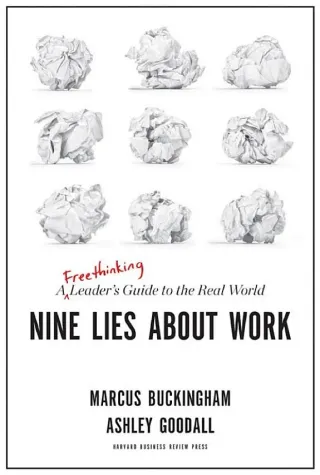
Hook
Almost everything your company believes about how to manage people is wrong — and the data has been hiding in plain sight for years.
What It’s About
Marcus Buckingham, co-author of First, Break All the Rules and one of the sharpest thinkers in the strengths-based management movement, teams up with Cisco executive Ashley Goodall to challenge nine deeply embedded assumptions that dominate modern corporate life. Each chapter takes a commonly accepted workplace truth and systematically demolishes it with a combination of rigorous data, incisive logic, and more than a little righteous frustration.
The nine lies include beliefs that most leaders take as gospel: that people care which company they work for (they actually care which team they are on), that the best plan wins (the best intelligence system wins), that people need feedback (they need attention), that people can reliably rate other people (they cannot), and that leadership is a thing (it is not — what we actually respond to is followership). Buckingham and Goodall argue that these lies persist not because they are true but because they are convenient for the people designing organizational systems.
The book is structured as a series of provocations, each building on the last. The authors move from individual-level lies (about feedback and strengths) to team-level lies (about culture and planning) to organizational-level lies (about leadership and work-life balance). Along the way, they make a compelling case that most corporate practices — from cascading goals to 360-degree reviews to competency models — are based on flawed assumptions and produce results that are, at best, useless and, at worst, actively harmful.
Key Takeaways
The most revolutionary idea in the book is the distinction between what they call “real” and “abstract” aspects of work. The real aspects — your team, your day-to-day experience, your specific strengths — matter enormously. The abstract aspects — your company’s culture statement, your strategic plan, your competency framework — matter far less than organizations believe. The implication is that companies spend enormous resources on systems and processes that have almost no impact on actual performance or engagement.
Buckingham and Goodall also offer a powerful reframe of feedback culture. They argue that the current obsession with giving constructive criticism is misguided because human beings learn and grow primarily through positive attention and recognition of what they do well, not through correction of what they do poorly. This is not a feel-good platitude but a data-driven argument rooted in neuroscience and decades of engagement research.
The Verdict
Nine Lies About Work is a fearless, evidence-driven demolition of corporate orthodoxy that should be required reading for anyone who designs, manages, or suffers through modern workplace systems.