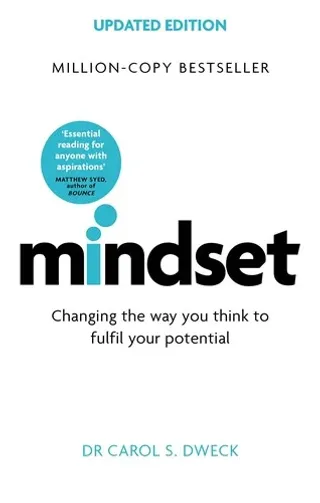
Hook
What if the single most important factor in your success isn’t talent, intelligence, or luck — but the way you think about those things? Carol Dweck’s decades of research reveal that your beliefs about your own abilities shape virtually everything in your life.
What It’s About
Stanford psychologist Carol Dweck spent years studying why some people thrive when faced with challenges while others crumble. Her answer is deceptively simple: it comes down to mindset. People with a “fixed mindset” believe their qualities — intelligence, talent, personality — are carved in stone. People with a “growth mindset” believe those same qualities can be developed through effort, good strategies, and input from others.
The distinction sounds academic, but Dweck shows how profoundly it plays out in real life. Fixed-mindset individuals tend to avoid challenges, give up easily, and feel threatened by the success of others. They spend their energy proving themselves rather than improving themselves. Growth-mindset individuals, on the other hand, embrace difficulty as an opportunity to learn, persist through setbacks, and find inspiration in others’ achievements. Dweck draws on research from classrooms, boardrooms, sports arenas, and relationships to illustrate how these two orientations lead to dramatically different outcomes.
What makes the book especially useful is that Dweck doesn’t just describe the problem — she offers a clear path forward. She explains how mindsets are formed, often in childhood through the way we’re praised and evaluated, and how they can be changed at any age. The final chapters provide practical guidance on cultivating a growth mindset in yourself, your children, and your organizations. She’s honest about the fact that shifting your mindset isn’t a one-time event but an ongoing practice, which makes the advice feel grounded rather than gimmicky.
Key Takeaways
The core insight is that believing your abilities are fixed creates a fragile sense of self that depends on constant validation, while believing your abilities can grow creates resilience and a genuine love of learning. This applies everywhere — in education, business, sports, and personal relationships. Dweck is particularly compelling when she discusses how praising children for being “smart” can actually backfire, making them afraid to take on challenges that might reveal they’re not as smart as everyone thinks.
Perhaps the most valuable takeaway is that a growth mindset isn’t about blind optimism or pretending that effort alone guarantees success. It’s about understanding that your potential is unknown and unknowable, and that the only way to find out what you’re capable of is to keep pushing, keep learning, and keep adapting. The research is robust, the examples are vivid, and the framework is one you’ll find yourself applying almost immediately.
The Verdict
A foundational book in psychology and personal development that earns its massive popularity — the growth mindset framework is one of those ideas that genuinely changes how you see yourself and others.