Hook
Selling professional services is nothing like selling products, yet most firms try to use the same playbook. Tom McMakin unpacks the unique psychology of how clients actually choose their advisors — and it has far less to do with credentials than you might think.
What It’s About
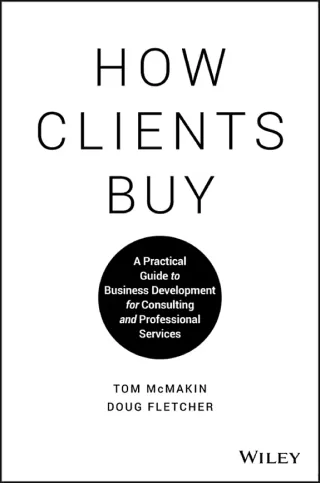
How Clients Buy tackles a question that haunts every consultant, agency owner, and professional services provider: how do clients actually make the decision to hire you? McMakin and his co-author Doug Fletcher argue that the buying process for professional services is fundamentally different from purchasing a product. You cannot test-drive a consultant. You cannot return bad advice. The purchase is inherently risky, deeply personal, and driven by trust rather than features.
The book introduces a framework built around seven elements that must be present before a client will engage: Awareness (they know you exist), Understanding (they know what you do), Interest (they have a need you might fill), Respect (they believe you are capable), Trust (they believe you will act in their interest), Ability (they have the budget and authority), and Readiness (the timing is right). McMakin argues that most business development efforts fail because they focus almost exclusively on Awareness and Understanding while neglecting the deeper elements of Respect and Trust that actually drive decisions.
The writing is conversational and grounded in real-world examples from professional services. McMakin draws on interviews with dozens of firm leaders and buyers to illustrate how relationships develop over time and why the firms that win work are rarely the ones with the flashiest marketing. Instead, they are the ones that have built genuine relationships and demonstrated competence through small interactions long before a formal engagement is ever discussed. The book also addresses the awkwardness that many professionals feel about selling, reframing business development as relationship building rather than persuasion.
Key Takeaways
The most valuable insight is that trust is the bottleneck in most professional services sales, and trust cannot be manufactured quickly. It is built through repeated, authentic interactions over time — shared experiences, demonstrated reliability, and genuine interest in the client’s challenges. This means that the best business development strategy is not a sales funnel but a relationship strategy: being consistently helpful, visible, and generous with your expertise long before you need anything in return.
The seven-element framework also serves as a useful diagnostic tool. When a prospective engagement stalls, you can work through the elements to identify which one is missing. Often it is not that the client does not understand your offering — it is that they do not yet trust you enough, or the timing simply is not right. This saves you from the common mistake of responding to every stalled deal by sending more information or lowering your price, when the real issue is something much more fundamental.
The Verdict
A thoughtful, practical guide to business development for professional services firms that reframes selling as relationship building — particularly valuable for consultants, advisors, and agency leaders who are strong practitioners but uncomfortable with traditional sales approaches.