Hook
Having conquered famine, plague, and war, humanity is now turning its ambitions toward something far more audacious — upgrading humans into gods.
What It’s About
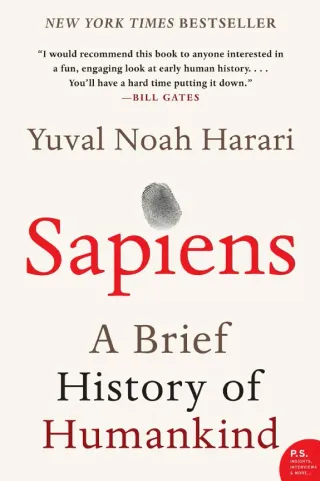
Homo Deus picks up where Harari’s blockbuster Sapiens left off, pivoting from the story of how Homo sapiens conquered the world to the far more unsettling question of what happens next. Harari argues that for most of human history, three problems dominated the agenda: famine, plague, and war. While none of these have been fully eradicated, they have been brought under sufficient control that humanity is now free to pursue a new set of ambitions: immortality, happiness, and divinity.
The book traces how humanism — the belief that human feelings and experiences are the ultimate source of meaning and authority — became the dominant ideology of the modern world. Harari then argues that the very technologies humanism unleashed, particularly artificial intelligence and biotechnology, are now poised to undermine it. If algorithms can know us better than we know ourselves, what happens to the humanist faith in free will and individual choice? If genetic engineering can reshape the human body and mind, what happens to the idea that all humans are created equal?
Harari does not claim to predict the future with certainty. Instead, he maps the landscape of possibilities, exploring scenarios ranging from the merely disruptive to the genuinely terrifying. He examines what happens when economic and military systems no longer need the masses, when a small elite can enhance themselves beyond recognition, and when data becomes the most valuable resource on earth. The result is a book that feels less like speculation and more like an early warning system.
Key Takeaways
The central takeaway is that the greatest threat to humanity may not come from external forces but from our own success. Harari makes a convincing case that the technologies we are building to solve today’s problems could create tomorrow’s crises — not through malice but through the relentless logic of optimization. When algorithms can make better decisions than humans in domain after domain, the philosophical foundations of liberal democracy begin to erode.
Equally important is Harari’s argument about the power of shared fictions. Just as Sapiens showed how myths and stories enabled large-scale human cooperation, Homo Deus explores how new narratives — particularly “Dataism,” the emerging belief that the universe consists of data flows and that the value of any entity is determined by its contribution to data processing — could reshape civilization in ways we are only beginning to comprehend.
The Verdict
Homo Deus is provocative, sweeping, and occasionally terrifying — a book that forces you to think seriously about where our species is headed, even if you disagree with some of Harari’s conclusions along the way.