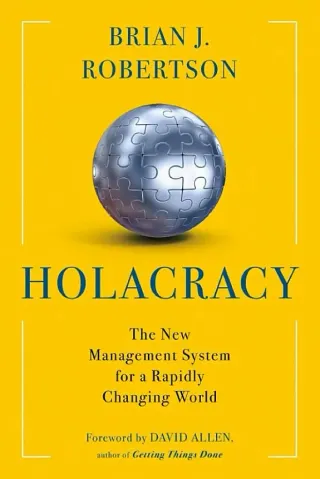
Hook
What would happen if you removed managers, job titles, and the traditional hierarchy from your organization entirely? Holacracy is the most serious attempt anyone has made to answer that question — and the results are more complicated than the evangelists or critics suggest.
What It’s About
Holacracy is Brian Robertson’s blueprint for a radical new way of running organizations. Instead of the traditional management hierarchy with bosses, direct reports, and top-down decision-making, Holacracy distributes authority into self-organizing roles defined by the work itself rather than by the people doing it. Each person fills multiple roles, each role belongs to a circle (roughly equivalent to a team), and governance happens through a structured meeting process rather than managerial decree.
Robertson, who developed the system at his software company Ternary, walks through the mechanics in detail. The book covers how roles are created and evolved through governance meetings, how tactical meetings replace status updates with real-time triage, how tensions (the gap between current reality and what could be) drive organizational change, and how authority flows through a constitution rather than through personalities. He draws on examples from companies that have adopted the system, most famously Zappos, and makes the case that traditional hierarchy is fundamentally broken for the complexity of modern work.
The book is at its best when describing the frustrations of conventional management — meetings where nothing gets decided, power concentrated in personalities rather than processes, the way job descriptions become political territory rather than functional tools. Robertson is clearly someone who has felt these problems deeply, and his diagnosis resonates. Where the book becomes more contentious is in its prescription. Holacracy is not a set of suggestions you can cherry-pick — it is a comprehensive operating system with its own constitution, and Robertson is explicit that partial adoption tends to fail. This all-or-nothing approach makes the system powerful in theory but intimidating in practice.
Key Takeaways
The most valuable concept in the book is the separation of role from soul. In traditional organizations, people and their positions become inseparable, which creates ego-driven politics and makes change painful. In Holacracy, roles are fluid and defined by purpose, and people can hold multiple roles across different circles. This means the organization can evolve rapidly without triggering the identity crises that typically accompany restructuring.
The governance meeting process is also genuinely innovative. Rather than consensus-based decision-making (which often leads to the lowest common denominator), Holacracy uses an integrative decision-making process that asks whether a proposal is safe enough to try rather than whether everyone agrees. This dramatically speeds up organizational adaptation. However, the system has significant drawbacks that the book somewhat glosses over: the learning curve is steep, the language can feel alienating, and the removal of traditional management can leave people feeling unmoored, especially those who thrive with clear mentorship and career paths. Holacracy works best in certain contexts — knowledge work, smaller organizations, cultures that value autonomy — and the book would benefit from more honesty about its limitations.
The Verdict
A thought-provoking and rigorous alternative to traditional management that every leader should understand, even if full adoption is too radical for most organizations.