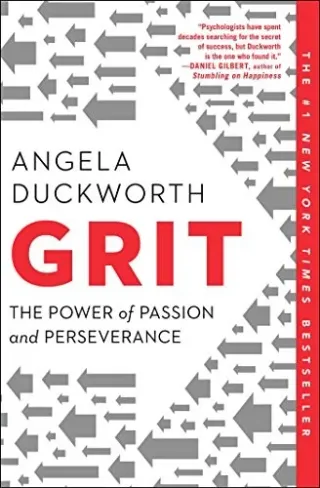
Hook
Talent is overrated. Angela Duckworth, a psychologist who left management consulting to teach seventh-grade math, spent years studying why some people succeed and others do not — and found that the answer has more to do with passion and perseverance than raw ability.
What It’s About
Angela Duckworth opens with a puzzle. At West Point, the U.S. Military Academy, the admissions process is one of the most rigorous in the world, evaluating candidates on academic achievement, physical fitness, and leadership potential. Yet every year, a significant number of cadets drop out during the brutal initial summer training program known as Beast Barracks. The dropouts are not the ones with the lowest test scores or the weakest bodies. The factor that best predicts who stays and who quits is something Duckworth calls “grit” — a combination of sustained passion for a long-term goal and the perseverance to keep working toward it even when progress is slow, boring, or painful.
Duckworth takes this finding and expands it across domains. She examines spelling bee champions, first-year teachers in tough schools, salespeople, and Green Berets, and in each case, grit emerges as a better predictor of success than talent, IQ, or socioeconomic background. Her argument is not that talent does not matter — of course it does — but that effort counts twice. Talent multiplied by effort produces skill, and skill multiplied by effort produces achievement. People who are slightly less talented but significantly grittier will, over time, outperform their more gifted but less persistent peers.
The second half of the book shifts from describing grit to explaining how to develop it. Duckworth identifies four psychological assets that gritty people share: interest (a genuine fascination with what they do), practice (a commitment to daily improvement), purpose (the belief that their work matters to others), and hope (the confidence that their efforts can improve their future). She argues that grit is not a fixed trait you either have or lack — it can be cultivated deliberately, both in yourself and in the cultures you create around you.
Key Takeaways
The most useful framework in the book is the distinction between top-level goals and lower-level goals. Gritty people are not simply stubborn about everything. They are remarkably flexible about tactics and intermediate goals, but deeply committed to their ultimate objective. A gritty novelist might abandon a particular draft, change publishers, or switch genres, but she never stops writing. This flexibility at the bottom combined with commitment at the top is what separates productive perseverance from blind stubbornness.
Duckworth also makes a compelling case about the role of culture in building grit. She points to environments like the Seattle Seahawks under Pete Carroll or the culture at Finnish schools, where the expectations, norms, and daily practices all reinforce the idea that effort is what matters most. Her advice for parents and managers is practical: require people (including yourself) to commit to hard things, stick with them for a defined period, and only then decide whether to continue or move on. The “Hard Thing Rule” she uses with her own children — everyone must do one hard thing, and you cannot quit in the middle of a season — is a simple, actionable framework that has resonated with readers around the world.
The Verdict
A persuasive and well-researched argument that perseverance matters more than talent — though it would benefit from being about 25% shorter and spending more time on the limits of its own thesis.