Hook
What do sumo wrestlers and schoolteachers have in common? More than you think — and once you start seeing the hidden incentives that shape human behavior, you will never look at the world the same way again.
What It’s About
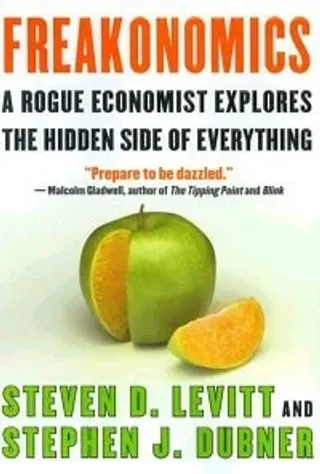
Freakonomics is what happens when a rogue economist and a journalist team up to explore the hidden side of everything. Steven Levitt is not interested in GDP forecasts or interest rate policy. Instead, he applies economic thinking — incentives, data analysis, conventional wisdom-busting — to questions nobody else thought to ask. The result is a book that reads more like a series of detective stories than a treatise on economics.
The book jumps between wildly different topics: cheating in sumo wrestling, the economics of drug dealing, the impact of a child’s name on their life outcomes, and what really caused the dramatic drop in American crime during the 1990s. Levitt’s controversial answer to that last question sparked enormous debate and remains one of the most talked-about claims in popular social science. Each chapter peels back assumptions and reveals that the world operates on incentive structures that are often invisible to us.
What ties it all together is a method rather than a subject. Levitt approaches every question by asking: what do the data actually say, and what incentives are at play? He shows that experts frequently exploit information asymmetry — real estate agents, for example, behave differently when selling their own homes versus their clients’ homes. The book is playful and accessible, and co-author Stephen Dubner deserves credit for translating Levitt’s academic work into prose that moves quickly and entertains throughout.
Key Takeaways
The biggest lesson is to question conventional wisdom relentlessly. The stories that society tells itself about cause and effect are often wrong, and the real answers are hiding in the data. Levitt demonstrates that morality and economics are more intertwined than we like to admit — people respond to incentives, and when the incentives change, behavior changes in predictable (and sometimes uncomfortable) ways.
The book also teaches a valuable intellectual habit: separating correlation from causation. Many of the most interesting findings in Freakonomics come from Levitt’s ability to find natural experiments in messy real-world data. This way of thinking — skeptical, data-driven, willing to follow evidence to uncomfortable conclusions — is arguably more valuable than any individual finding in the book.
The Verdict
Freakonomics is a wildly entertaining introduction to thinking like an economist about everyday life — a book that will sharpen your bullshit detector and make you question assumptions you did not even know you held.