Hook
There is a state of consciousness where time dissolves, self-doubt vanishes, and you perform at your absolute best. Mihaly Csikszentmihalyi spent decades studying it — and his findings changed how we think about happiness, work, and human potential.
What It’s About
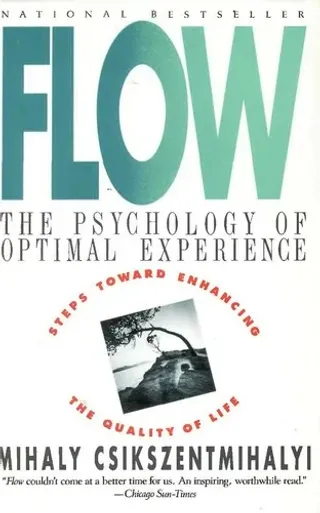
Flow is the landmark book that introduced the concept of optimal experience to a mainstream audience. Mihaly Csikszentmihalyi (pronounced “cheek-sent-me-high”) spent decades researching what makes people genuinely happy — not in a fleeting, hedonic sense, but in a deep, enduring way. His conclusion, based on thousands of interviews across cultures and professions, is that the best moments in life are not passive or relaxing. They occur when a person is voluntarily stretched to their limits in pursuit of something challenging and worthwhile.
The book defines flow as a state of complete absorption in an activity, where your skills are perfectly matched to the challenge at hand. In flow, you lose track of time, your sense of self recedes, and the activity becomes intrinsically rewarding. Csikszentmihalyi explores how flow shows up in every domain of life — work, play, relationships, solitary activities — and argues that learning to create the conditions for flow is the closest thing we have to a reliable path to happiness.
The scope of the book is ambitious. It covers the anatomy of consciousness, the conditions that produce flow, how different activities (sports, music, reading, conversation) can be structured to maximize it, and how flow applies to work, relationships, and even coping with adversity. Csikszentmihalyi also tackles the broader philosophical question of meaning, arguing that a life organized around flow experiences naturally develops a sense of purpose and coherence. The writing is academic in places — this is a researcher sharing his life’s work, not a self-help guru dispensing tips — but the ideas are so powerful that they reward patience.
Key Takeaways
The conditions for flow are surprisingly specific and replicable. You need clear goals, immediate feedback, and a challenge that matches your skill level — not too easy (which produces boredom) and not too hard (which produces anxiety). When these conditions are met, consciousness narrows to the task at hand, and the experience becomes its own reward. Csikszentmihalyi calls this autotelic experience, and he argues it is the foundation of a well-lived life.
One of the book’s most valuable insights is that flow is not limited to elite athletes or artists. It can be cultivated by anyone, in almost any context. A factory worker who finds ways to challenge themselves, a parent who turns play into genuine engagement, a commuter who uses drive time for structured thought — all of these can produce flow. The key is not what you do, but how you structure your attention while doing it. This reframe is genuinely liberating: it means that happiness is less about your circumstances and more about how you engage with them. The book is dense and occasionally academic, but its core ideas have influenced everything from game design to workplace culture to sports psychology.
The Verdict
A foundational text in positive psychology that remains as relevant today as when it was published — essential reading for anyone who wants to understand what makes life genuinely satisfying.