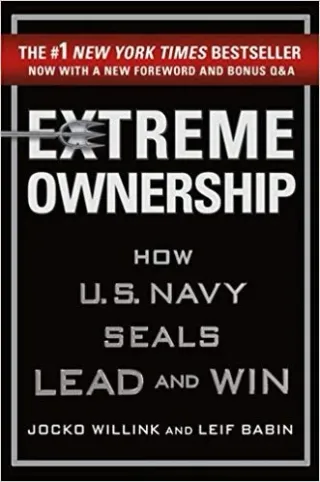
Hook
Two Navy SEAL officers take the hardest lessons from the battlefields of Ramadi, Iraq, and show how they apply to boardrooms, teams, and everyday leadership — with an uncompromising message that the responsibility for everything always starts with you.
What It’s About
Jocko Willink and Leif Babin led SEAL Task Unit Bruiser during the Battle of Ramadi, one of the most violent and complex urban combat operations in recent American military history. In Extreme Ownership, they take the leadership principles they forged in that crucible and translate them into a framework that applies far beyond the military.
The book alternates between two kinds of chapters. First, a gripping battlefield narrative that illustrates a principle in life-or-death terms. Then, a business case study showing that exact same principle at work in the corporate world, drawn from the authors’ post-military consulting work. The structure works remarkably well. You read about a firefight where friendly forces nearly killed each other due to a communication breakdown, and then you see how the same failure pattern plays out in a manufacturing company losing market share. The parallels are not forced — they are genuinely illuminating.
The core thesis is right there in the title. Extreme ownership means that a leader takes complete responsibility for everything in their world. Not just their own actions, but the actions of their team, the clarity of their communication, and even the failures of people above and below them in the chain of command. When something goes wrong, the first question is always: what could I have done differently? This is not about self-flagellation. It is about recognizing that blame is useless and that the only productive response to failure is to look inward and find what you can control. Willink models this powerfully with a story about a devastating friendly-fire incident where he, as the commander, stood before his superiors and took full responsibility rather than pointing fingers at the many other people who contributed to the disaster.
Key Takeaways
The book lays out a set of leadership laws that feel almost too simple on paper but prove devastatingly effective in practice. Leaders must believe in the mission before they can convince their team. Plans must be simple enough that everyone understands them. Ego is the single most dangerous threat to a team’s performance. Decentralized command — pushing decision-making authority down to the people closest to the action — is essential for operating in complex environments.
What sets this apart from most leadership books is the weight of the source material. These are not hypothetical frameworks dreamed up in a business school. They were tested under fire, literally, and the consequences of getting them wrong were measured in lives. That gravity gives the advice a seriousness that is hard to dismiss. The business applications sometimes feel slightly less urgent by comparison, but they serve their purpose: proving that these principles are universal, not just military.
The Verdict
One of the most impactful leadership books of the last decade — direct, practical, and backed by the kind of experience that makes theoretical leadership advice feel hollow by comparison.