Hook
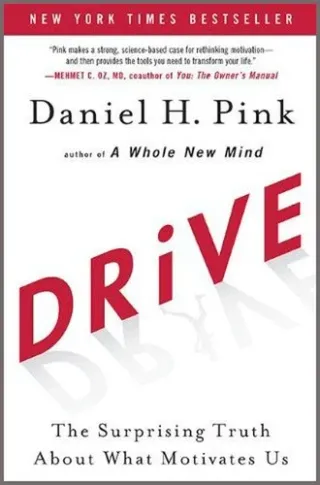
Everything you think you know about motivation is probably wrong. Daniel Pink synthesizes decades of behavioral science to argue that carrots and sticks are relics of a bygone era — and that the real engines of human drive are autonomy, mastery, and purpose.
What It’s About
Drive opens with a puzzle that has been nagging researchers for decades: why do people sometimes perform worse when you pay them more? Pink traces the answer through a fascinating tour of motivation science, beginning with the work of Harry Harlow and Edward Deci, whose experiments revealed that intrinsic motivation — the desire to do something because it is inherently interesting or satisfying — is a powerful force that external rewards can actually undermine.
Pink organizes human motivation into three historical phases. Motivation 1.0 was about survival — finding food, avoiding predators. Motivation 2.0 was the carrot-and-stick model that powered the Industrial Revolution: reward desired behavior, punish undesired behavior. This worked reasonably well for routine, mechanical tasks. But in an economy that increasingly depends on creative, conceptual work, Motivation 2.0 is not just inadequate — it is counterproductive. Enter Motivation 3.0, built on three pillars: autonomy (the desire to direct your own life), mastery (the urge to get better at something that matters), and purpose (the yearning to serve something larger than yourself).
The book is packed with examples from both research and real-world organizations. Pink examines companies like Atlassian and Google that give employees dedicated time for self-directed projects, the open-source software movement as a case study in purpose-driven work, and the science behind flow states and deliberate practice. He also addresses when old-style incentives still work — for routine, algorithmic tasks where creativity is not required — which adds nuance to what could otherwise feel like an absolutist argument.
Key Takeaways
The autonomy-mastery-purpose framework is genuinely useful for anyone who manages people or designs organizations. Pink’s most practical insight is that intrinsic motivation is not a luxury — it is a necessity for any work that requires creativity, judgment, or complex problem-solving. The research he cites on the “overjustification effect,” where external rewards reduce internal motivation, is both well-documented and frequently ignored by organizations that still rely heavily on bonuses and performance incentives.
The book also does an excellent job of connecting individual motivation to organizational design. If you want people to be self-directed, you have to give them actual autonomy — over their tasks, their time, their technique, and their team. This is not a soft philosophy; it is a structural argument backed by robust evidence.
The Verdict
A compelling, well-researched argument that will change how you think about what motivates people — and a practical guide for leaders who want to stop managing with carrots and sticks.