Hook
What separates companies that endure for generations from those that flame out after a few good years? Jim Collins and Jerry Porras spent six years researching that question, and their findings challenged nearly everything the business world assumed about success.
What It’s About
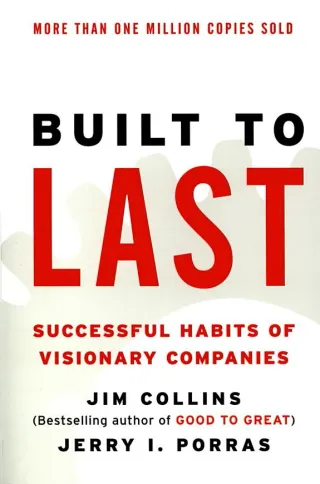
Built to Last is one of the foundational texts of modern business strategy. Collins and Porras studied eighteen “visionary” companies — organizations like 3M, Disney, Johnson & Johnson, and Procter & Gamble that have been industry leaders for decades — and compared each one against a carefully selected rival that started in the same era, in the same industry, but did not achieve the same lasting greatness. The research question was simple: what makes the difference?
The findings were surprising, even counterintuitive. Visionary companies were not necessarily founded by charismatic visionaries. They did not always start with a breakthrough product or a brilliant strategy. What they did have was a relentless commitment to a core ideology — a set of values and a sense of purpose beyond just making money — combined with an equally relentless drive to stimulate progress, experiment, and evolve. Collins and Porras call this the “genius of the AND”: the ability to hold two seemingly contradictory forces in productive tension rather than choosing one or the other.
The book introduces several frameworks that have become part of the business vocabulary. “Clock building, not time telling” argues that great founders build organizations that can thrive beyond their tenure rather than depending on a single leader’s genius. “Try a lot of stuff and keep what works” captures the evolutionary approach to innovation that characterized companies like 3M. “BHAGs” — Big Hairy Audacious Goals — describes the kind of bold, clear, long-term targets that galvanize organizations. Each concept is backed by detailed comparative analysis.
Key Takeaways
The central lesson is that enduring greatness comes from building an institution, not from riding a single product, strategy, or leader. The visionary companies in the study were not more successful because they made better predictions about the future. They were more successful because they built cultures and systems that could adapt to any future. Core ideology stayed fixed; everything else was open to change.
The comparison methodology gives the findings unusual credibility. By matching each visionary company against a direct competitor and asking why one thrived while the other merely survived, Collins and Porras avoid the common trap of cherry-picking success stories. That said, the book is now thirty years old, and some of the featured companies have stumbled since publication — a reminder that no framework guarantees permanence. The principles still hold up remarkably well, even if the examples occasionally show their age.
The Verdict
A foundational business book that has earned its classic status — still essential reading for anyone building an organization meant to last, with the caveat that no company is truly invincible.