Hook
Nassim Nicholas Taleb doesn’t just want you to survive chaos — he wants you to build a life, a career, and a worldview that actually gets stronger from it.
What It’s About
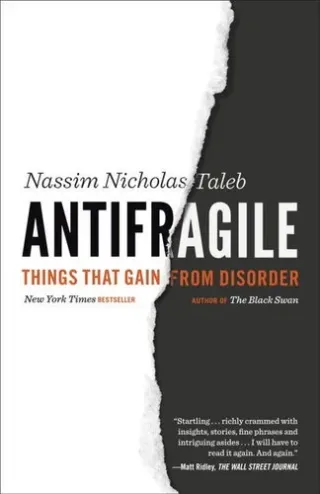
Taleb introduces a concept that he argues has been missing from our vocabulary and our thinking: antifragility. We all know what fragile means — things that break under stress. And we know what robust or resilient means — things that withstand stress. But Taleb points out that there’s a third category we’ve been ignoring: things that actually benefit from stress, disorder, and volatility. He calls these things antifragile, and he argues that understanding this concept changes how you should think about almost everything.
The book is a sprawling, combative, wildly ambitious tour through domains as varied as medicine, politics, urban planning, fitness, finance, and philosophy. Taleb argues that modern society has become dangerously fragile by trying to eliminate volatility and uncertainty from every domain. We over-medicate, over-plan, over-regulate, and over-optimize, creating systems that look stable on the surface but are catastrophically vulnerable to unexpected shocks. The better approach, he argues, is to build systems — and lives — that have optionality, that benefit from small stresses, and that limit downside risk while maintaining unlimited upside.
Taleb is a polarizing writer, and this book is a perfect illustration of why. His ideas are genuinely original and often brilliant, but they come wrapped in an aggressive, digressive, and sometimes self-indulgent prose style. He picks fights with academics, economists, and anyone he considers a “fragilista” (his term for people who make things more fragile while thinking they’re helping). If you can get past the personality — and honestly, it’s part of the charm for many readers — the intellectual content is extraordinary. The book doesn’t just describe a concept; it provides a new lens through which to evaluate decisions, policies, and institutions.
Key Takeaways
The most immediately applicable idea is the “barbell strategy” — avoiding the middle and combining extreme safety with extreme risk. In finance, this means keeping most of your assets in ultra-safe instruments while taking small, speculative bets with big potential upside. In career terms, it means having a stable income source while pursuing high-risk, high-reward side projects. The logic is that this approach limits your downside while maintaining exposure to positive surprises.
Equally powerful is Taleb’s concept of “skin in the game” and his critique of people who make decisions without bearing the consequences. He argues that systems work best when decision-makers are exposed to the results of their decisions — and that many of modernity’s problems stem from separating authority from accountability. The practical takeaway is to be deeply skeptical of advice from people who don’t bear the costs of being wrong, and to build your own life so that you have optionality rather than fragile dependencies on any single outcome.
The Verdict
A demanding but genuinely transformative book that introduces one of the most important concepts in modern thinking — Taleb’s personality isn’t for everyone, but his ideas are essential.