Hook
A skeptical, hard-charging news anchor has a panic attack on live television, reluctantly discovers meditation, and finds that it actually works — just not in the way the self-help industry promises.
What It’s About
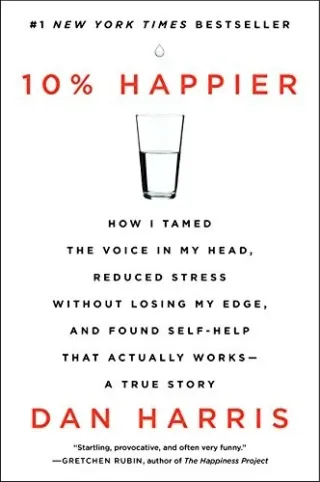
Dan Harris was a rising star at ABC News, co-anchoring Nightline and filling in on Good Morning America, when his career took a detour he never expected. After covering wars in Afghanistan and Iraq, he developed an undiagnosed case of depression that led to recreational drug use, which culminated in a full-blown panic attack on live national television. That very public meltdown sent him on a journey through the world of self-help, spirituality, and eventually meditation — despite every fiber of his being resisting anything that sounded remotely “woo-woo.”
The book is part memoir, part meditation primer, and the balance is what makes it work. Harris is brutally honest about his own flaws — the ambition that borders on obsession, the ego that drives him, the skepticism that almost kept him from discovering something genuinely useful. He takes the reader through encounters with Deepak Chopra, Eckhart Tolle, and various spiritual teachers, approaching each with the sharp eye of a journalist. Some he finds genuinely helpful. Others he finds absurd. He does not pretend that meditation is a miracle cure or that he has achieved enlightenment. His claim is far more modest and far more credible: meditation made him roughly ten percent happier.
What sets this apart from most mindfulness books is the voice. Harris writes like a journalist, not a guru. He is funny, self-deprecating, and refreshingly allergic to the kind of vague, blissed-out language that fills most books in this category. He makes meditation accessible to exactly the kind of person who would never pick up a meditation book — the type-A, high-strung, results-oriented skeptic who thinks mindfulness is for people who own too many crystals.
Key Takeaways
The core insight Harris arrives at is that meditation is not about achieving some state of cosmic peace. It is about developing the ability to notice your own thoughts and reactions without being automatically controlled by them. That tiny gap between stimulus and response — the moment where you can choose not to snap at a colleague or not to spiral into anxiety — is where the real benefit lives. It is not dramatic, but it is genuinely transformative in the accumulation of hundreds of small daily moments.
Harris also makes an important distinction between the useful core of mindfulness and the questionable baggage that often surrounds it. You do not need to believe in anything supernatural, adopt a particular lifestyle, or buy any special equipment. The practice itself is almost absurdly simple: sit quietly, focus on your breath, notice when your mind wanders, and gently bring it back. The difficulty is not in the technique but in the consistency, and Harris is honest about how hard that consistency is to maintain even when you know it works.
The Verdict
The best introduction to meditation for people who think they would hate meditation — honest, funny, and refreshingly free of mystical nonsense.